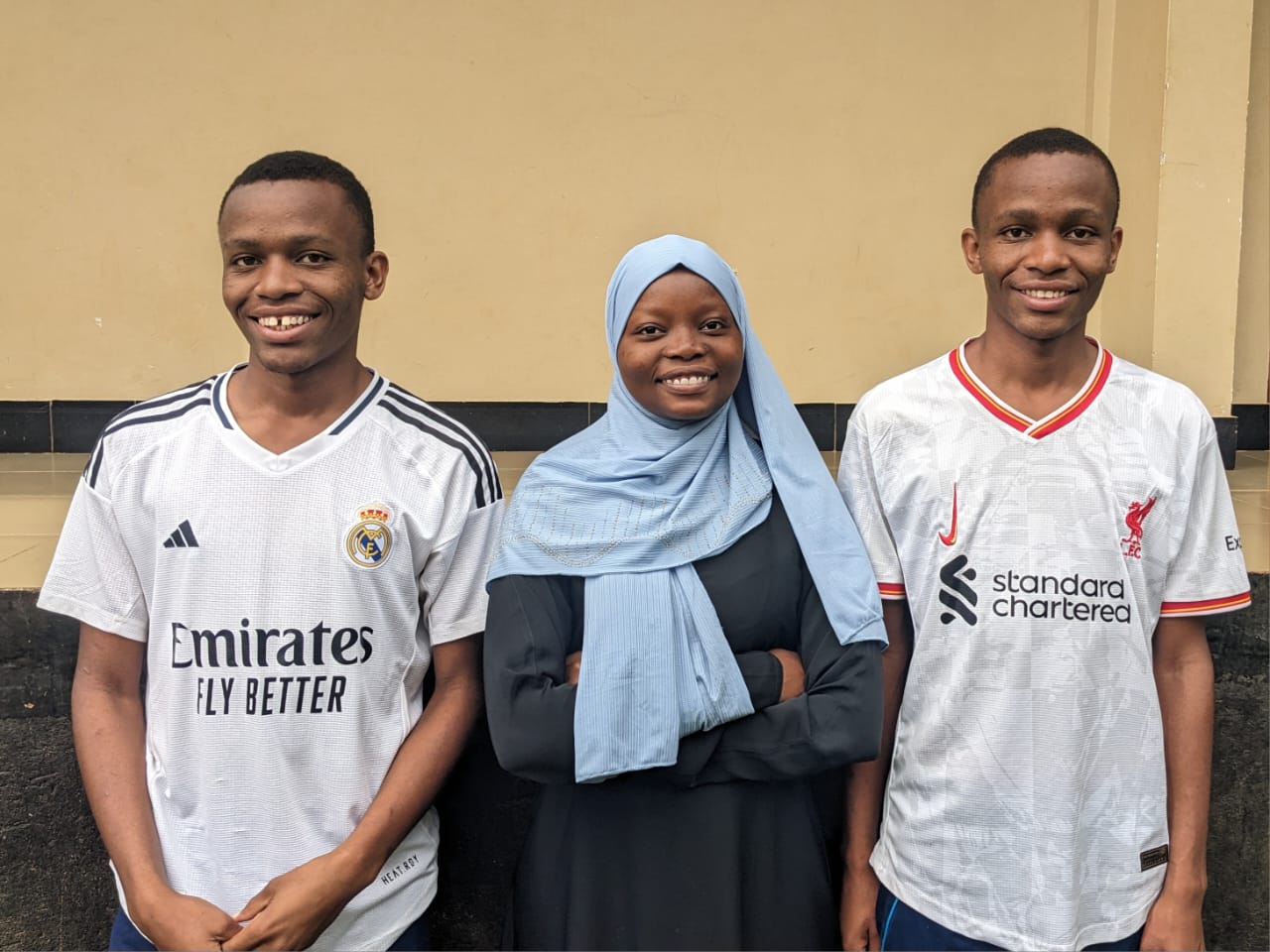
Denice grew up in the Kilimanjaro region, the third of four children in a family that lived day‑to‑day. His parents were small‑scale farmers, earning just enough to survive. “We were raised in a family where sometimes we slept without eating anything,” he says. Hunger was not an occasional hardship — it was a familiar part of life.
He began primary school in 2012, walking more than eight kilometres each day. Many mornings he made the long journey on an empty stomach. “I remember feeling so tired and hungry, but I still tried to learn,” he says. Eventually, the strain became too much, and he dropped out. At home, his older sister taught him arithmetic and reading while he helped his mother with household chores.
A year later, his mother enrolled him in a different school, three kilometres away. Even then, school was never guaranteed. “We studied only six months of the year,” he explains. “The rest of the time, we stayed home to help our mother earn an income.” He struggled with English, and criticism from classmates stung. But instead of giving up, he pushed himself harder. By Standard Four, his determination began to shine: his grades rose rapidly, and he finished primary school with the highest marks in his class.
Then tragedy struck. While Denice was in Form Three, his father died from liver failure. With her husband gone, his mother could no longer afford school costs. Their future felt uncertain — until a local chairman told her about Kijana Kwanza and its sponsorship programme.
The very next day, she brought Denice to meet the team. “I explained our life at home in tears,” he remembers. “I didn’t believe one day our life could change.” A month later, his mother received the call that he had been accepted. It was the moment everything shifted.
With school fees, supplies, and monthly food parcels finally covered, Denice could focus on his education. He scored Division One in his secondary examinations and progressed to advanced studies in Physics, Chemistry, and Biology (PCB), where he continued to excel. After completing Form Six, he spent a year volunteering at Kijana Kwanza’s Children’s Homes, teaching mathematics and physics. “I wanted to give back and share what I had learned,” he says. “I knew how hard it was to study without support.” Watching the students grow in confidence gave him a deep sense of purpose.
At Kijana Kwanza, Denice also gained skills he never imagined having — including computer literacy, which he had never been exposed to before. Regular physical exercise kept him mentally and physically strong, helping him thrive academically. He made new friends, found mentors, and discovered a community that believed in him.
Now, Denice is preparing to join university in October. “I feel excited and hopeful,” he says. “This is the chance I’ve been waiting for — to continue my education and build a better future.” His long‑held dream is to become a doctor, and in 2026 he plans to apply for medical school. It is a dream rooted not only in ambition, but in gratitude. “I really don’t know where I would be without this support,” he says. “Kijana Kwanza gave me the strength to keep going.”
He also sees the organisation’s wider impact — helping young people build skills, encouraging entrepreneurship, and reducing social problems such as crime and drug abuse. “It doesn’t just help individuals,” he says. “It strengthens the whole community.”
To the supporters who made his journey possible, Denice’s message is one of gratitude: “You changed my life. I remember the hardship we lived in, and now I feel hope, confidence, and joy. You gave me the chance to dream, to grow, and to believe in myself. Thank you — for everything.”